


Anno Domini 1227
Read
Two players. Church against Empire. Paper. One hour.
What lies on the table




- Board with 18 realms
- Neighbour list
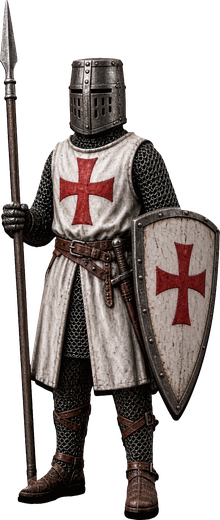
- Standees: pope 85 mm, emperor 85 mm, three orders 65 mm
- Antipope card (stays with the emperor, is not placed)
- Dice: up to three D6 per player
- Slip of paper for troop numbers
Tin and STL stay closed. Today only cardboard counts.
Setup
- 1The pope places his standee on Church / Rome.
- 2The emperor places his standee on Empire / Frankfurt. A second marker or the same standee note counts for Sicily — same player, second space.
- 3The three orders stand on their seats: Templars Southern France, Teutonic Order Baltic, Hospitallers Cyprus. In the test they belong to no one until someone enters their space or takes them as allies. Simpler: in the first test the orders stay neutral and unmoving.
- 4All other realms are neutral. Whoever attacks a neutral space fights the starting number from the list (France 50, England 36, …). Neutral defends, does not attack.
- 5Starting troops of the required players: Emperor 60 split on Empire and Sicily (for the test: 45 Empire, 15 Sicily). Pope: 50 on Church.
A player’s turn
Only one of the three actions:
- 1Move — troops into an owned or empty neighbouring space. Neighbours from the list only. Sea only where “(Sea)” is written.
- 2Attack — a neighbouring space owned by the opponent or a neutral.
- 3Card — the emperor may play the Antipope card. The pope draws no card in this test.
Then the other player goes.
Combat
- 1Both say how many they fight with. At least 1 must remain in the starting space if that space is owned.
- 2Combat value: soldier = 1. Knight (order) = 2.
- 3Dice: attacker at most 3, defender at most 2.
- 4Highest against highest, then second against second. Ties go to the defender.
- 5Each lost comparison: attacker −1 soldier, defender −1 soldier (order −1 knight).
- 6Defender bonus: if the defender has more combat value, +1 on every die. Double or more: +2.
- 7Combat runs in rounds until one side clears the space or is destroyed. Whoever clears the space retreats only into owned neighbours.
Antipope in the test

No figure. No space.
Once per game the emperor may lay the card face up.
Effect for the test (small, so it does not eat the game): this round and the next, the pope may not attack Sicily.
Then the card leaves the game.
If the effect feels too weak or too strong: strike it out, write one new sentence.
Victory in the test
- The emperor enters Rome. Imperial victory.
- The pope enters Frankfurt, or Sicily and Frankfurt — for the first test Frankfurt is enough. Papal victory.
- After 8 rounds each: whoever holds more capitals (Rome, Frankfurt, Palermo, plus captured neutral capitals) wins. Tie: whoever has more troops.
- Capturing a neutral counts. Whoever takes a neutral capital writes the name on the slip.
What you note after the round
- Which border felt wrong?
- Was Sicily too far, too close, too empty?
- Did the Antipope card change anything — or did it only lie there?
- Standee size: 85 mm hero beside 65 mm order — tip over? Too large for the space?
Crossing out on the neighbour list counts as a rule. Do not argue, write.
What you are not testing
- 18 human players
- Alliances across three rounds
- Crusade and excommunication cards of the pope
- Real tin casting
That comes once Church against Empire has held for an hour on paper.
A teaching project. Non-commercial. Idea: Diego. Built with Grok Build.